How much can I put toward my credit card this paycheck?
Take what's in checking, subtract every bill due before your next paycheck and a small cushion. What's left is the most you can safely pay. Then let a card absorb everyday spending and pay the most you can each payday.

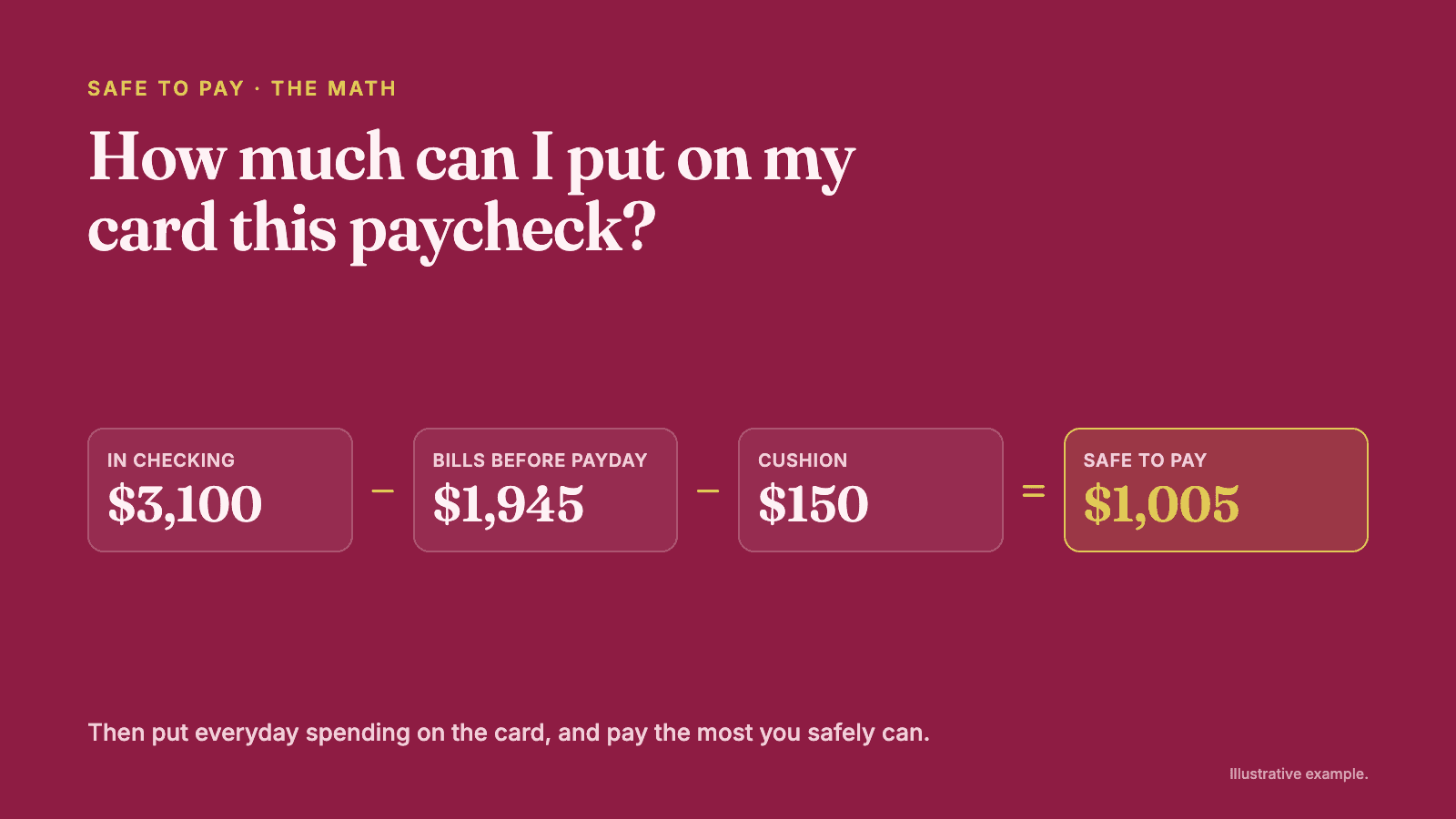
Short answer: take what's in checking right now, subtract every bill due before your next paycheck (plus whatever your next paycheck can't cover on a heavy bill day, like the 1st), then subtract a small cushion (at least your bank's minimum balance). What's left is the most you can safely put on your card today. Then run your everyday spending through a card and pay the most you safely can every payday.
Below is exactly how to work it out yourself, on a notepad or in a spreadsheet, step by step.
The formula
Safe to pay = money in checking − bills due before your next paycheck − cushion
Money in checking: what's actually there today, after your paycheck lands. Not what you expect to have.
Bills due before your next paycheck: every predictable payment that leaves checking between now and the next payday. Rent or mortgage, utilities, phone, insurance, subscriptions, loan payments, and the minimum on every other card.
Cushion: at least your bank's minimum balance, so you never trigger a fee or an overdraft, plus a little extra for something you forgot.
Do it by hand: four steps
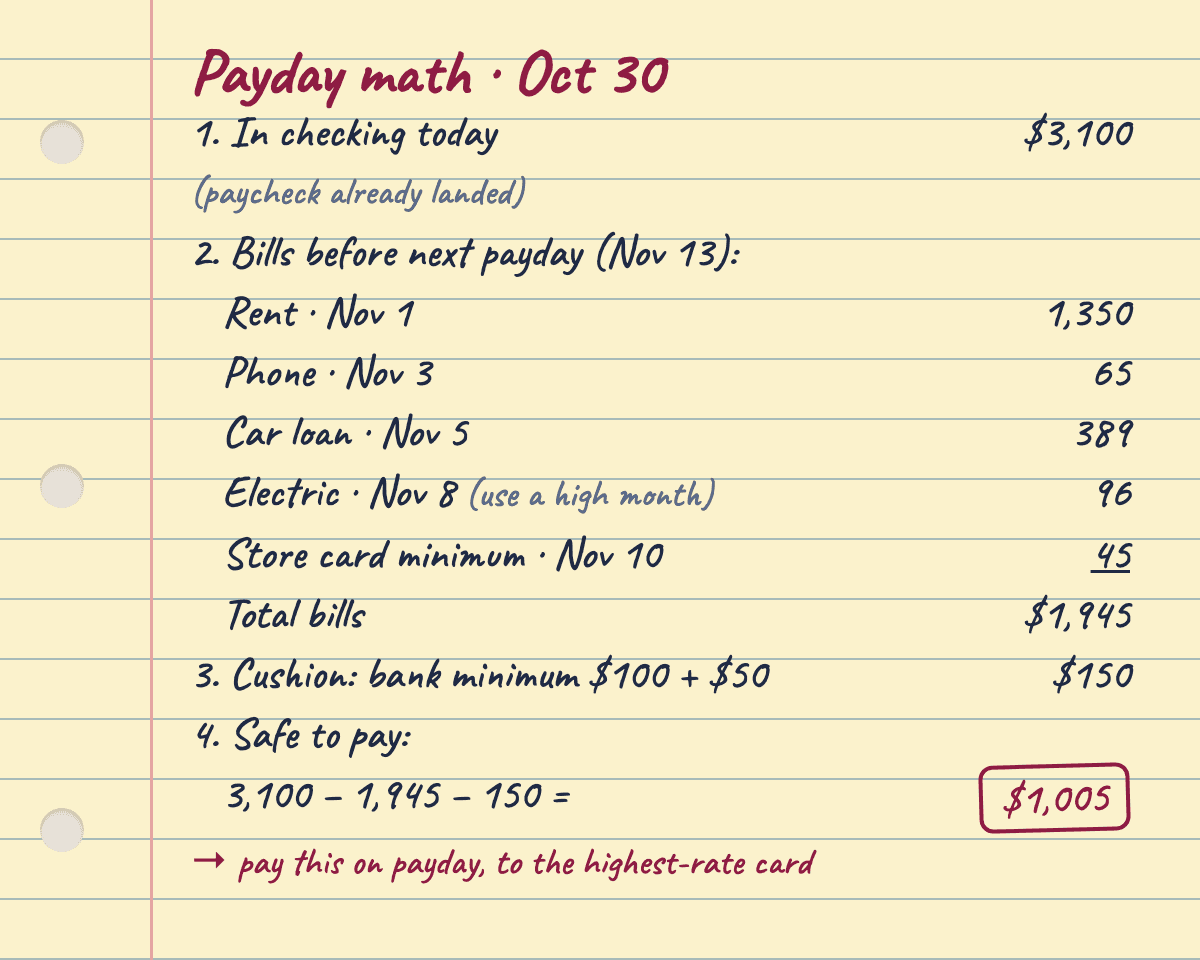
Grab a notepad, or open your bank app and a notes app. This is an illustrative example: your paycheck landed on Oct 30, and the next one comes Nov 13.
Step 1: Write down what's in checking right now
Open your bank app and write the available balance, not the pending total. In the example it's $3,100.
Step 2: List every bill that leaves checking before your next paycheck
Go through last month's statement and your calendar. For each bill, write the date it actually comes out and the amount:
Rent, Nov 1: $1,350
Phone, Nov 3: $65
Car loan, Nov 5: $389
Electric, Nov 8: about $96. For bills that vary, use a recent high month, not the average.
Store card minimum, Nov 10: $45
Add them up: $1,945. Only count what lands before Nov 13. A bill due the day after payday belongs to the next paycheck's math.
Step 3: Pick your cushion
Start with your bank's minimum balance (check your account terms; $100 here), then add a little for anything you forgot. Here that's $150.
Step 4: Subtract
$3,100 − $1,945 − $150 = $1,005. That's the most you can safely put on your card this paycheck.
Double-check it: walk the balance day by day
The four steps tell you the total. A running balance makes sure you never dip too low between paydays, for example when rent comes out the day after you pay the card.
In a spreadsheet, make five columns: Date, What, Note, Amount out, Checking balance. Start the balance column with today's balance. Each row below is the row above minus this row's amount (in Google Sheets or Excel, =E2-D3, then fill down). Put the card payment first, then each bill on its date.
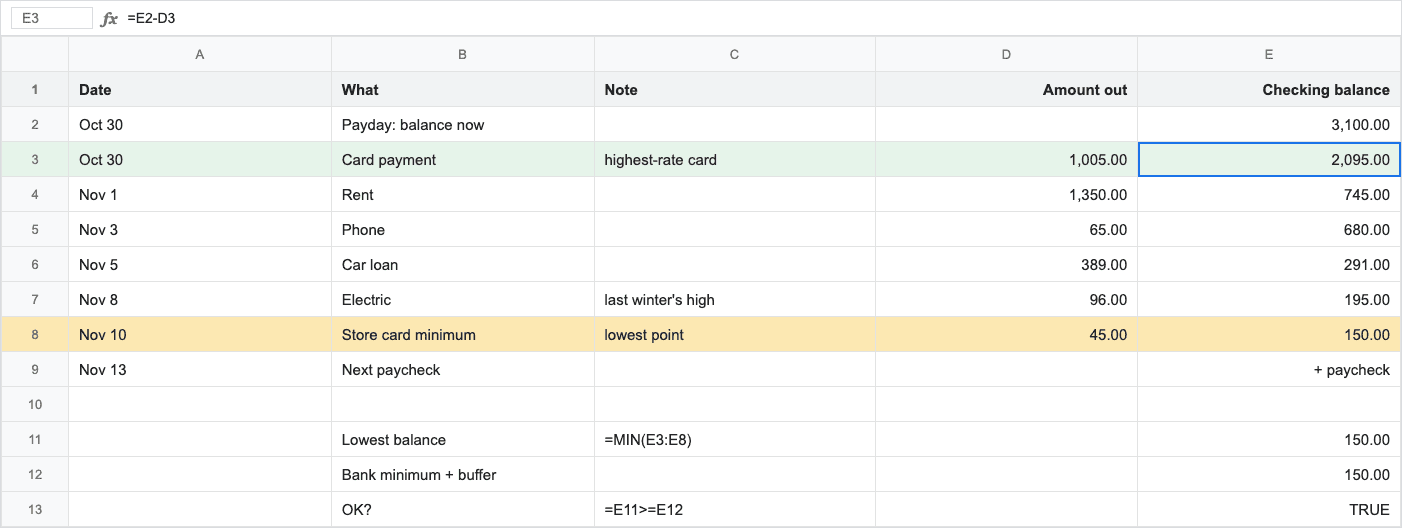
Then check the lowest point with =MIN() over the balance column, and compare it to your cushion. Here the balance bottoms out at exactly $150 on Nov 10, the day the last bill clears, so $1,005 is safe. If the lowest point were below your cushion, pay a little less until it isn't.
Amount
Show data
| Amount | |
|---|---|
| In checking now | $3,100 |
| Bills before next payday | $1,945 |
| Cushion | $150 |
| Safe to put on the card | $1,005 |
When one paycheck can't cover a heavy day
Many people have a heavy day: often the 1st, when rent, a car loan and a few bills all come out at once. If the paycheck right before that day is smaller than the bills on it, the four steps above will tell you to pay too much. They only look as far as your next paycheck, and the heavy day is just past it.
An illustrative example: you're paid $1,450 every other Friday, on Oct 16 and Oct 30. After the Oct 16 paycheck lands you have $1,900 in checking. Your bills:
Before your next paycheck: electric, Oct 22: $96.
The heavy day, Nov 1: rent $1,350, car loan $389 and phone $65. That's $1,804, two days after the Oct 30 paycheck.
The four steps say: $1,900 − $96 − $150 cushion = $1,654. Pay that and you'd have $150 when the Oct 30 paycheck arrives, so $1,600 on Oct 30. Then $1,804 leaves on Nov 1 and you're $204 overdrawn.
The fix: save the shortfall from this paycheck
Work out what the paycheck before the heavy day can't cover, and hold that back now:
Shortfall: heavy-day bills − the paycheck before it. $1,804 − $1,450 = $354.
Safe to pay now: the four-step answer − the shortfall. $1,654 − $354 = $1,300.
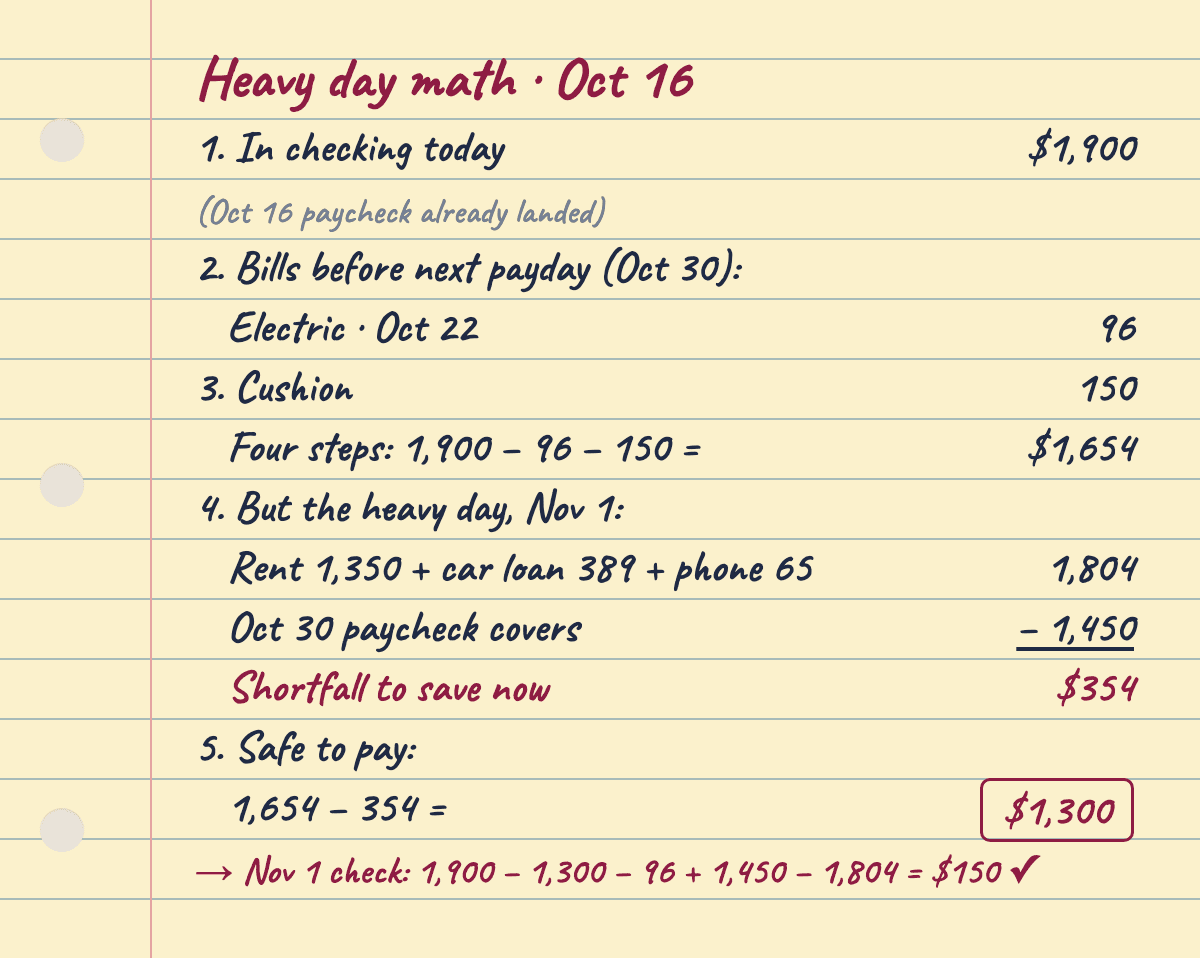
Check it: pay $1,300 on Oct 16 and you have $600. The electric bill takes it to $504. The Oct 30 paycheck brings it to $1,954. After the $1,804 on Nov 1 you're left with exactly your $150 cushion.
In your spreadsheet, the same check is simply a longer walk. Don't stop at your next payday: keep adding rows until you're past the heavy day and the bills that follow it, then take the lowest balance with =MIN(). Safe to pay = that lowest balance − your cushion. Here the lowest point is $1,450 on Nov 1 (before paying anything extra), so $1,450 − $150 = $1,300, the same answer.
Unpredictable spending: let a card absorb it
Groceries, gas, a copay, a birthday gift. This spending is real, but you can't know the exact amount or the day. Many people leave extra money sitting in checking “just in case”. That works, but the money does nothing while it waits.
Another way: put your everyday spending on a credit card, and pay the card the most you safely can every payday. Your checking then only has to cover the predictable bills from your list, so your finances stay predictable and you never go below your bank's minimum. The surprises land on the card, and next payday's math picks them up.
The money that would have sat in checking goes toward your debt today, not two weeks from now. The card balance is lower almost every day of the pay period, so you pay less interest.
Show data
| Day of pay period | Pay $405, keep $600 in checking | Pay $1,005, spend on the card |
|---|---|---|
| 1 | $4,595 | $3,995 |
| 14 | $4,595 | $4,295 |
In this example the card starts at $5,000 at 24% APR, and you spend about $300 over the 14 days. Keeping $600 aside in checking and paying $405 leaves an average card balance of $4,595. Paying $1,005 and putting the $300 of spending on the card averages about $4,134.
Keep $600 in checking
$42.30
Average card balance $4,595
Pay the most, spend on the card
$38.06
Average card balance about $4,134
Saved this pay period$4.24
Show data
| Value | ||
|---|---|---|
| Keep $600 in checking | $42.30 | Average card balance $4,595 |
| Pay the most, spend on the card | $38.06 | Average card balance about $4,134 |
| Saved this pay period | $4.24 |
About $4 less interest every pay period, or roughly $110 over a year in this example, from the same paycheck and the same spending. You owe the same at the end; you just paid less to get there.
Which card gets the spending, and which gets the payment?
Spend on the card with the lowest interest rate. Whatever it carries until your next payment costs the least there.
Not on a 0% promo or balance-transfer card you're paying off. New purchases on those cards are often charged the card's regular rate, and they make it harder to see whether you'll clear the promo balance before the promo ends. When the promo runs out, whatever is left starts charging full interest. Keep that card's balance shrinking and spend on your lowest-rate regular card instead.
Send the safe-to-pay amount to the highest-interest balance, or to a promo balance that won't be cleared before its end date, after every card gets at least its minimum.
On paper: list your cards with their rates and any promo end date. Circle the lowest-rate regular card (spend there) and star the highest-rate one (pay there). Redo it whenever a promo is about to end or a card is paid off.
The rules that make this work
Only put spending on the card that you'd have spent anyway. The card is a timing tool, not extra money.
Pay every card at least its minimum by its due date, every month.
Keep your cushion. Never pay so much that checking dips below your bank's minimum.
Pay the card on payday, as much as is safe, and do it again next payday.
If the balance isn't going down overall, stop and rethink. This only helps while you're paying it off.
Or let Croft do it
Doing this by hand every payday works, but it's a chore: bills move, minimums change, promo dates sneak up. Croft connects to your checking (read-only, so it can't move your money), finds your bills and paychecks, and shows a live safe-to-pay number and your lowest point, so you can pay the most you safely can without a spreadsheet. Create your free account and see your own numbers in a few minutes.