Getting off cash advances: a realistic way out
Croft's position: cash advance apps keep people short, and we want people off them for good. How the cost adds up, why the payback cycle repeats, and, if you use one, a step-down plan to $0.

Croft's position: cash advance apps keep people short, and we want people off them for good. We say that about the product, never about anyone who uses one. The apps are built to be easy to tap, and plenty of people do.
By cash advance apps we mean apps that pay part of a paycheck before payday, then take it back straight from the person's bank account on payday, along with any fees or tips. Some employers offer a version through payroll, often called early pay or earned wage access. It works the same way: money from the next paycheck, today. [2]
Here's why we're against them. Because the app is paid back first, the next pay period starts short, so people tap again. South Carolina now makes these companies report their numbers. In its first report, covering 2024, the average user took 25 advances in a year, 42.8% of users took more than 12, and people paid a fee or a tip on 79% of advances. The average user paid $88.22 in fees and tips. [1]
This post explains how the cost adds up and why the cycle repeats. If you use one of these apps, it ends with a step-down plan that gets you to zero without coming up short on rent week, so your whole paycheck is yours again.
How the payback works
The federal consumer bureau describes these products as "repayable on the next payday or withheld from the next paycheck." [2]
The advance itself isn't the only thing that leaves the account. These apps make their money from extras:
Express fees. A charge to get the money in minutes instead of days.
Tips. The app asks for one.
Memberships. Some apps charge a monthly price.
The express fee is the big one. In the South Carolina data, express delivery fees made up 91% of all the money these companies collected. [1]
A worked example: three months of advances
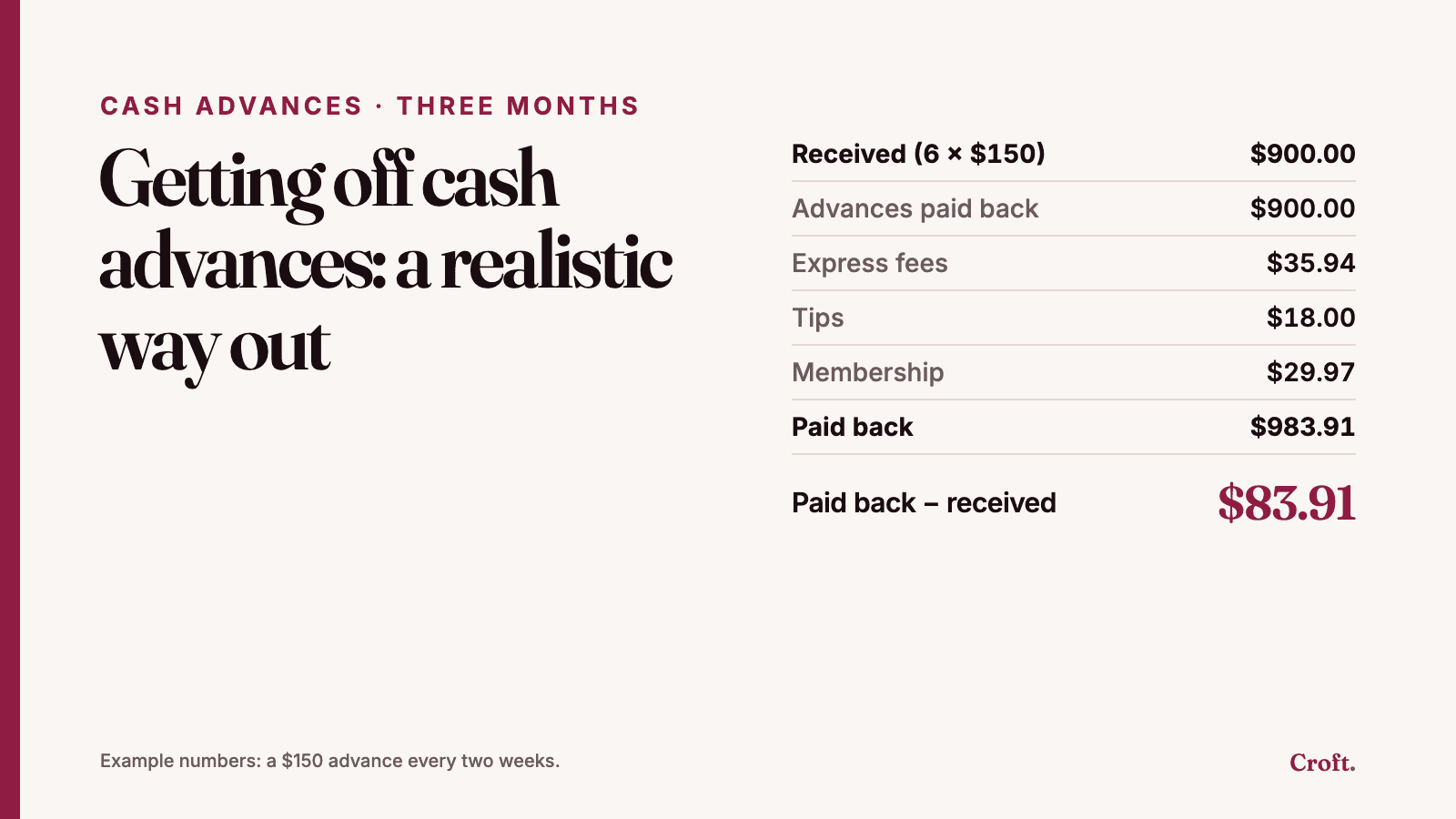
These are example numbers. Say someone is paid every two weeks. Each payday they take a $150 advance, pay a $5.99 express fee and add a $3 tip. The app also charges $9.99 a month. Over three months, that's six paydays.
Three months, six paydays | Amount |
|---|---|
Received (6 advances of $150) | $900.00 |
Advances paid back (6 × $150) | $900.00 |
Express fees (6 × $5.99) | $35.94 |
Tips (6 × $3) | $18.00 |
Membership (3 × $9.99) | $29.97 |
Paid back | $983.91 |
Paid back − received | $83.91 |
That $83.91 went out and never came back. Kept up for a full year (26 advances), it comes to $353.62. And at the end of the three months, the next $150 is still needed, because nothing about the cycle has changed.
Why the cycle repeats
An advance moves money from next payday to today. The total stays the same, minus what it costs.
Say the paycheck is $1,100 (example). The app pulls back $150 plus the $8.99 express fee and tip. That leaves $941.01 to cover two weeks that cost $1,100. It's short by about the same amount as last time, so another advance follows. Each round feels like a fix. Each round starts the next two weeks short again.
That's why stopping all at once is hard. Quitting cold means one paycheck has to cover two weeks plus the gap. If that's the paycheck that pays rent, it's the one week that can't come up short. So the way out is gradual, and it has an end.
If you use one: the way out
The goal is to shrink the gap a little each payday, so no single paycheck takes the whole hit, until there's no gap left.
See what it really costs you. Add up what went out to the apps and what came in from them over the last few months. The difference is money you'll get back for good once you're out.
Mark rent week. Look at your next two months and circle the paycheck that pays rent. You won't take a step down on that one.
Shrink each advance by a fixed amount. Pick a step you can live with, like $25. Then go $150, $125, $100, $75, $50, $25, $0. Skip the step on rent week and pick it up the next payday.
Find the $25 each time. This is the honest part. A $25 smaller advance means $25 less this pay period. Pick one thing to trim, like one takeout meal or one store run.
Build a small buffer. Once you're at $0, keep setting aside what used to go to fees and tips each payday. Over a few months it becomes a cushion of your own, so a short week doesn't send you back.
Cancel the membership and delete the app once you've gone one full month without an advance.
In the example, you're out in about seven paydays, or eight if one is a rent-week pause. That's three to four months to get your whole paycheck back.
What not to do
Don't stack apps. A second app can cover the first app's payback. Then two apps pull from the same paycheck, and payday shrinks twice.
Don't swap one advance for another. Moving to a different app, a different kind of early pay or a payday loan keeps the same cycle going. The way out is less each payday until it's zero.
Don't wait for a perfect month. A $25 step on a normal payday is enough to start.
Using one of these apps doesn't mean anyone did something wrong. They're built to be easy to tap. Getting out takes a plan, and this is one.
How Croft helps
The short version
Cash advance apps move money from next payday to today, and the extras mean more goes out than comes in. That's a loop, and Croft is against it. If you use one, you can get out: shrink each advance by a fixed step until it's zero, skip the step on rent week, and keep what used to go to fees as your own buffer. A few months from now, your whole paycheck is yours again.
Sources:
South Carolina Department of Consumer Affairs, [2025 Earned Wage Access Data Report](https://www.consumer.sc.gov/sites/consumer/files/Documents/Reports/2025%20EWA%20Report%20Draft%20FINAL.pdf), March 31, 2026 (calendar-2024 data).
Consumer Financial Protection Bureau, [Data Spotlight: Developments in the Paycheck Advance Market](https://www.consumerfinance.gov/data-research/research-reports/data-spotlight-developments-in-the-paycheck-advance-market/), July 18, 2024.