When is a balance transfer a good idea?
A balance transfer helps when the fee is less than the interest you'd pay, you can clear the balance before the 0% rate ends, and you stop adding charges. Here's the math, with a $6,000 example and a $200-a-month case.

A balance transfer is a good idea when the fee costs less than the interest you'd pay otherwise, you can clear the balance before the 0% rate ends, and you stop adding new charges to it. If any of those three is shaky, it can cost more than it saves, or just push the problem back a year.
Here's how to check, with real numbers you can redo on the back of an envelope.
How a balance transfer works
You open a card (or use one you have) with a promotional rate, usually 0%, and move debt from a higher-rate card onto it. Most cards charge a balance transfer fee of 3% to 5% of the amount moved, often with a small dollar minimum, and the fee is added to the balance. Intro periods vary; the longest offers this year run about 21 months.
When a standard 0% promo ends, only the balance still left starts being charged the card's regular rate, from that date forward. There's no charge for the months that were already at 0%.
Don't confuse it with deferred interest
Store cards and some financing plans say "no interest if paid in full" within a set time. That's deferred interest, and it works differently: if any of that balance is left when the period ends, interest is added going back to the original purchase date, on the full amount. A 0% intro APR says "0% intro APR". Read the wording before you sign.
A worked example: $6,000 at 24%
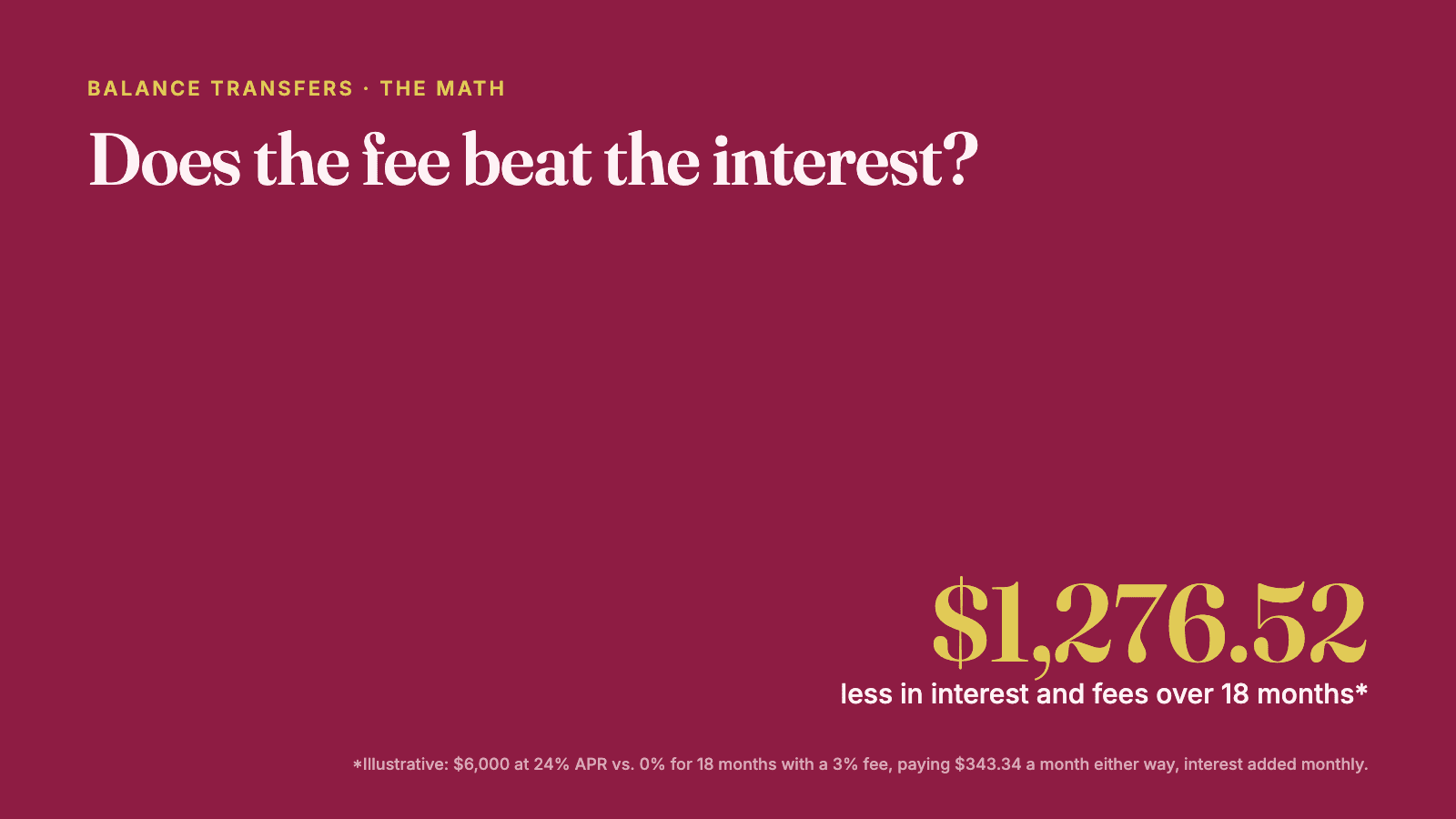
Say you owe $6,000 on a card at 24% APR. You're offered 0% for 18 months with a 3% fee. To keep the math simple, interest here is 2% a month, added once a month.
The fee: $6,000 × 3% = $180. Your new balance is $6,180.
The payment to clear it in time: $6,180 ÷ 18 = $343.33, so pay $343.34 a month (the last payment is $343.22).
If you keep it on the 24% card and pay the same $343.34: it takes 22 months and costs $1,456.52 in interest. After 18 months you'd still owe $1,217.76.
If you move it: it's gone in 18 months and the only cost is the $180 fee. That's $1,276.52 less.
Show data
| Month | Keep on 24% card | 0% transfer (3% fee) |
|---|---|---|
| 0 | $6,000 | $6,180 |
| 1 | $5,776.66 | $5,836.66 |
| 2 | $5,548.85 | $5,493.32 |
| 3 | $5,316.49 | $5,149.98 |
| 4 | $5,079.48 | $4,806.64 |
| 5 | $4,837.73 | $4,463.30 |
| 6 | $4,591.14 | $4,119.96 |
| 7 | $4,339.62 | $3,776.62 |
| 8 | $4,083.07 | $3,433.28 |
| 9 | $3,821.39 | $3,089.94 |
| 10 | $3,554.48 | $2,746.60 |
| 11 | $3,282.23 | $2,403.26 |
| 12 | $3,004.53 | $2,059.92 |
| 13 | $2,721.28 | $1,716.58 |
| 14 | $2,432.37 | $1,373.24 |
| 15 | $2,137.68 | $1,029.90 |
| 16 | $1,837.09 | $686.56 |
| 17 | $1,530.49 | $343.22 |
| 18 | $1,217.76 | $0 |
| 19 | $898.78 | $0 |
| 20 | $573.42 | $0 |
| 21 | $241.55 | $0 |
| 22 | $0 | $0 |
The break-even point is quick to find. At 24%, $6,000 costs about $120 in interest in the first month. The $180 fee equals 1.5 months of that interest. So if you'd need more than a month or two to pay the card off anyway, the transfer comes out ahead, as long as you finish it in time.
Keep on 24% card
$1,456.52
interest over 22 months
0% transfer
$180
3% fee, no interest
Less with the transfer+$1,276.52
Show data
| Value | ||
|---|---|---|
| Keep on 24% card | $1,456.52 | interest over 22 months |
| 0% transfer | $180 | 3% fee, no interest |
| Less with the transfer | +$1,276.52 |
What if you can only pay $200 a month?
That's real life for many people living paycheck to paycheck, and it changes the picture.
On the 24% card: $200 a month takes 47 months and costs $3,254.66 in interest.
On the transfer card: after 18 months you've paid $3,600, so $2,580 is left when the promo ends. At 24% that's about $51.60 of interest in the first month. Keep paying $200 and it's gone 16 months later, for $433.93 in interest plus the $180 fee: $613.93 in all.
The transfer still saves a lot here, but notice what happens: the 0% clock runs out with $2,580 still owed, and the regular rate takes over. The savings come from the months at 0%, not from the promo making the debt disappear. If that card's regular rate is higher than 24%, the cost after the promo is higher too.
Show data
| Month | Keep on 24% card | 0% transfer, then 24% |
|---|---|---|
| 0 | $6,000 | $6,180 |
| 1 | $5,920 | $5,980 |
| 2 | $5,838.40 | $5,780 |
| 3 | $5,755.17 | $5,580 |
| 4 | $5,670.27 | $5,380 |
| 5 | $5,583.68 | $5,180 |
| 6 | $5,495.35 | $4,980 |
| 7 | $5,405.26 | $4,780 |
| 8 | $5,313.37 | $4,580 |
| 9 | $5,219.64 | $4,380 |
| 10 | $5,124.03 | $4,180 |
| 11 | $5,026.51 | $3,980 |
| 12 | $4,927.04 | $3,780 |
| 13 | $4,825.58 | $3,580 |
| 14 | $4,722.09 | $3,380 |
| 15 | $4,616.53 | $3,180 |
| 16 | $4,508.86 | $2,980 |
| 17 | $4,399.04 | $2,780 |
| 18 | $4,287.02 | $2,580 |
| 19 | $4,172.76 | $2,431.60 |
| 20 | $4,056.22 | $2,280.23 |
| 21 | $3,937.34 | $2,125.83 |
| 22 | $3,816.09 | $1,968.35 |
| 23 | $3,692.41 | $1,807.72 |
| 24 | $3,566.26 | $1,643.87 |
| 25 | $3,437.59 | $1,476.75 |
| 26 | $3,306.34 | $1,306.29 |
| 27 | $3,172.47 | $1,132.42 |
| 28 | $3,035.92 | $955.07 |
| 29 | $2,896.64 | $774.17 |
| 30 | $2,754.57 | $589.65 |
| 31 | $2,609.66 | $401.44 |
| 32 | $2,461.85 | $209.47 |
| 33 | $2,311.09 | $13.66 |
| 34 | $2,157.31 | $0 |
| 35 | $2,000.46 | $0 |
| 36 | $1,840.47 | $0 |
| 37 | $1,677.28 | $0 |
| 38 | $1,510.83 | $0 |
| 39 | $1,341.05 | $0 |
| 40 | $1,167.87 | $0 |
| 41 | $991.23 | $0 |
| 42 | $811.05 | $0 |
| 43 | $627.27 | $0 |
| 44 | $439.82 | $0 |
| 45 | $248.62 | $0 |
| 46 | $53.59 | $0 |
| 47 | $0 | $0 |
The math you can do by hand
Fee: balance × fee rate. $6,000 × 0.03 = $180.
Interest you pay now, per month: balance × APR ÷ 12. $6,000 × 0.24 ÷ 12 = $120.
Break-even: fee ÷ monthly interest. $180 ÷ $120 = 1.5 months. Will you need longer than that to pay it off? Then the fee is likely worth it.
Payment to clear it in time: (balance + fee) ÷ promo months. $6,180 ÷ 18 = $343.33. Round up.
What's left if you pay less: (balance + fee) − (your payment × promo months). $6,180 − ($200 × 18) = $2,580.
Step 2 is a rough figure. As you pay the balance down, the monthly interest shrinks, which is why the real totals above come from month-by-month math. For a quick yes or no, the rough version is enough.
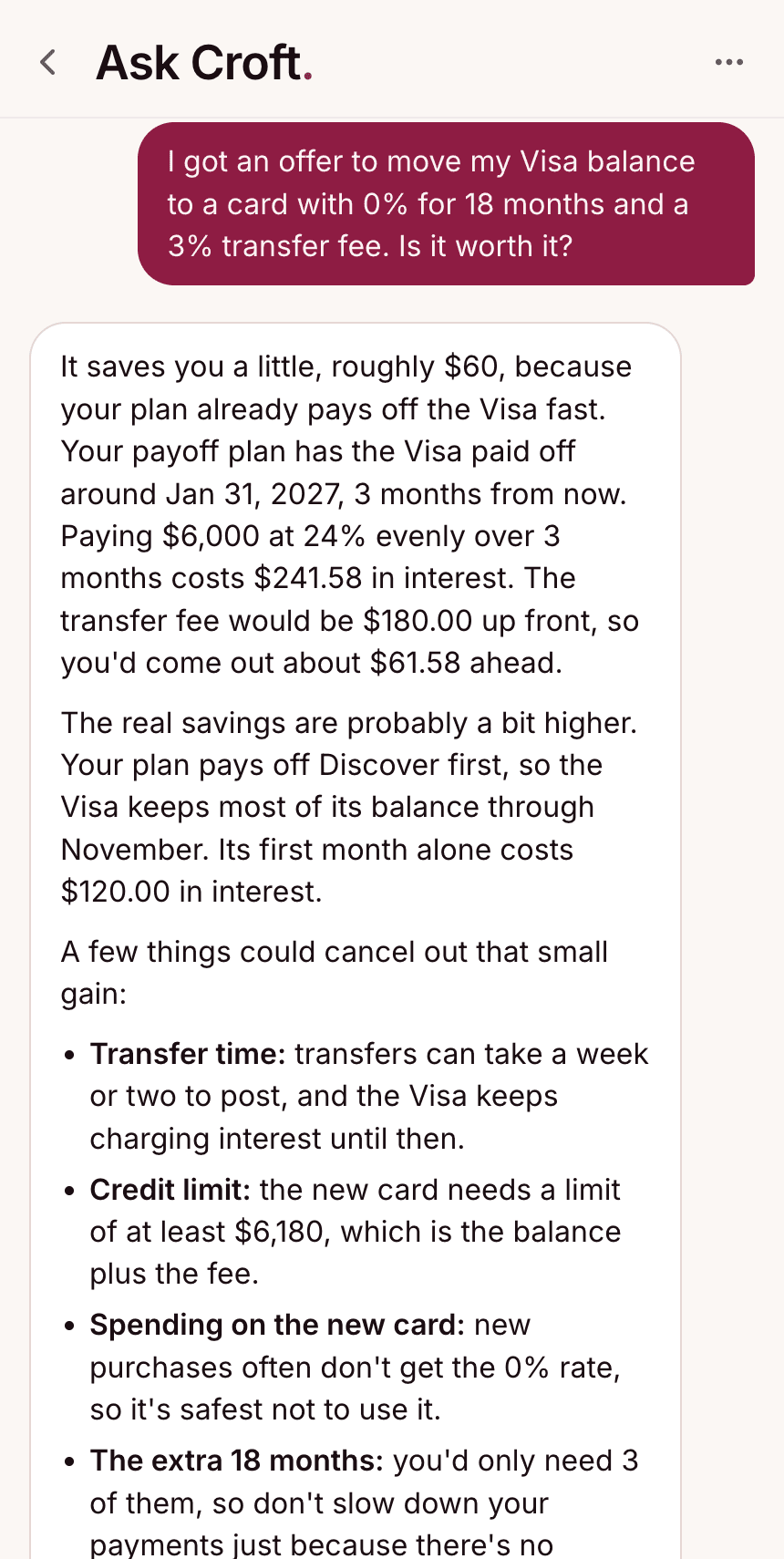
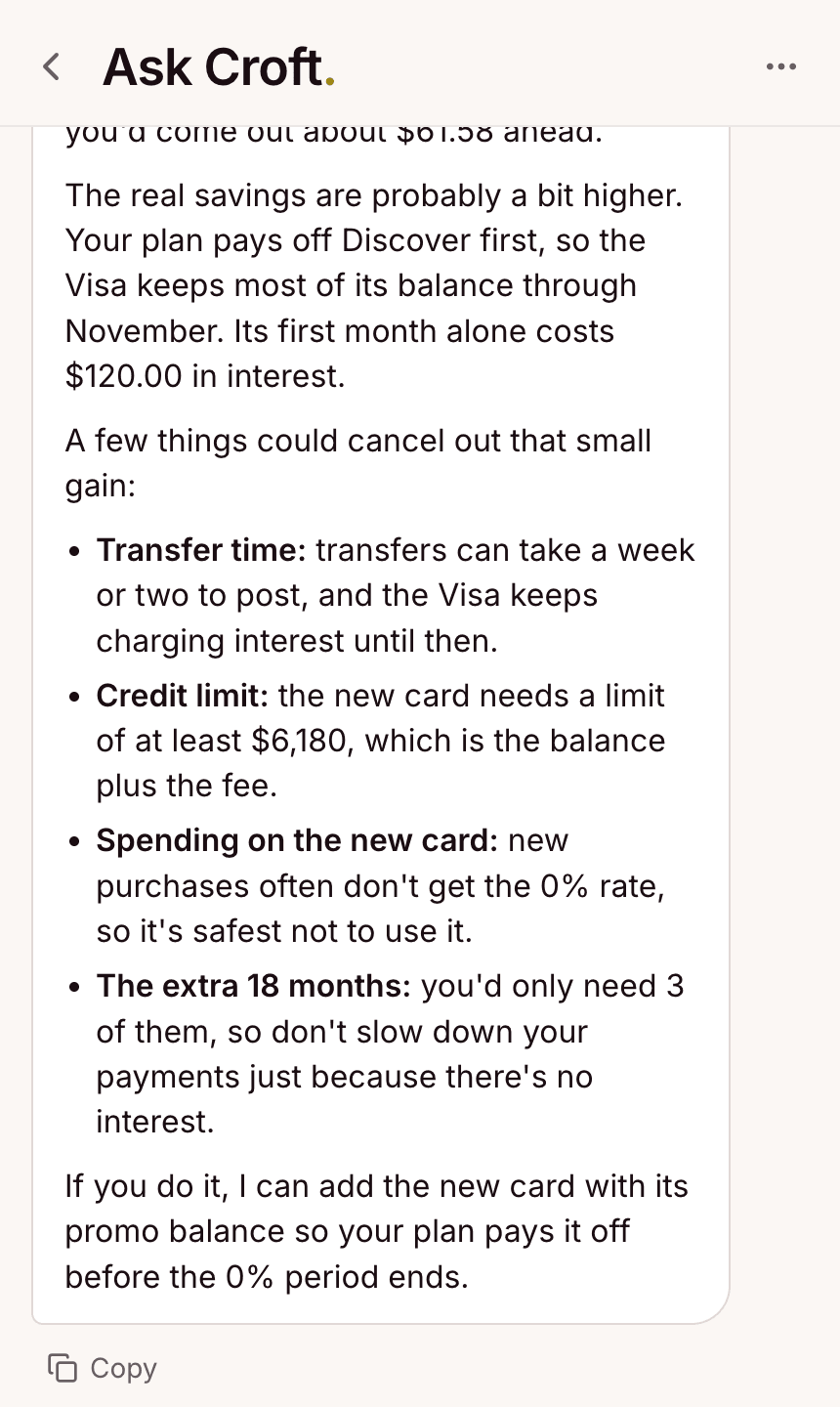
Or ask Croft. Ask Croft checks an offer against your own payoff plan. Here it is answering the same offer for a sample account that owes $6,000 at 24% on a Visa, plus other debts. That plan already pays the Visa off in about three months, so the fee only saves around $60. It's close to the "you'd pay it off in a month or two anyway" case from the list below.
When a balance transfer is not a good idea
You'd pay it off in a month or two anyway. The fee can be more than the interest you'd save.
You'll keep spending on the old card. Moving the balance frees up that card. If it fills back up, you now have two balances.
You plan to use the new card for purchases. New purchases often get the regular APR. And if you carry a balance (including the transferred one), purchases usually start charging interest right away; you lose the grace period unless you pay the whole balance in full.
It's a store card's "no interest if paid in full" deal. Miss the deadline by a dollar and the back interest is added.
The limit you get won't cover enough of the debt. A small transfer may not move the needle once the fee is counted.
You're about to apply for a mortgage or car loan. A new card means a hard inquiry, and timing can matter. More on that below.
Two rules that work against you
How payments are applied. Federal rules say any amount you pay above the minimum must go to the balance with the highest APR first. The minimum itself can go wherever the issuer chooses, often to the lowest rate. So if you put new purchases on the transfer card, your extra payments go to those purchases first, and the 0% balance barely moves.
Late payments. Pay at least the minimum on time every month. Late fees apply, and if a payment is more than 60 days late, the issuer can raise the rate on your existing balance after giving notice.
What it does to your credit score
Applying for a new card adds a hard inquiry, which can lower scores a little for a while, and a new account lowers your average account age. On the other side, the new credit line raises your total available credit. If your total balances stay the same, your utilization (how much of your credit you're using) goes down, which tends to help. The biggest help over time is the balance actually shrinking.
A balance transfer makes sense when…
The fee is less than the interest you'd pay over the time it will take you to pay off the debt. Use the break-even step above.
You can pay it off before the promo ends. Check it: divide the balance plus the fee by the number of promo months. Can you pay that every month?
You'll stop adding new charges to the transfer card, and won't run the old card back up.
It's a true 0% intro APR, not a deferred-interest offer.
You can make every payment on time. Set up autopay for at least the minimum.
When the promo is about to end
Find the exact end date on your statement or in the card's app. Put it in your calendar three months ahead.
Divide what's left by the months remaining. That's your new target payment. Split it across paychecks if that's easier.
Put any spare money there first while it's still at 0%, after your minimums on other debts are covered.
If you can't finish in time, know the regular APR it will switch to, and plan the payment that clears the rest. In the $200 example, about $244 a month would clear the $2,580 in 12 months at 24%.
Only consider another transfer if the math still works. The new fee has to be less than the interest you'd save, and approval isn't guaranteed. Rolling a balance from card to card without paying it down just adds fees.
How Croft helps
Croft tracks promo end dates and tells you how much to pay each paycheck to clear a promo in time. When a promo balance is at risk of running out the clock, it puts that card first in your payment plan.