
Does paying your credit card on payday save interest? The actual math
Yes, if you carry a balance. Most cards charge interest on your average daily balance, so paying the same amount right after payday instead of on the due date means less interest. Here's the math.

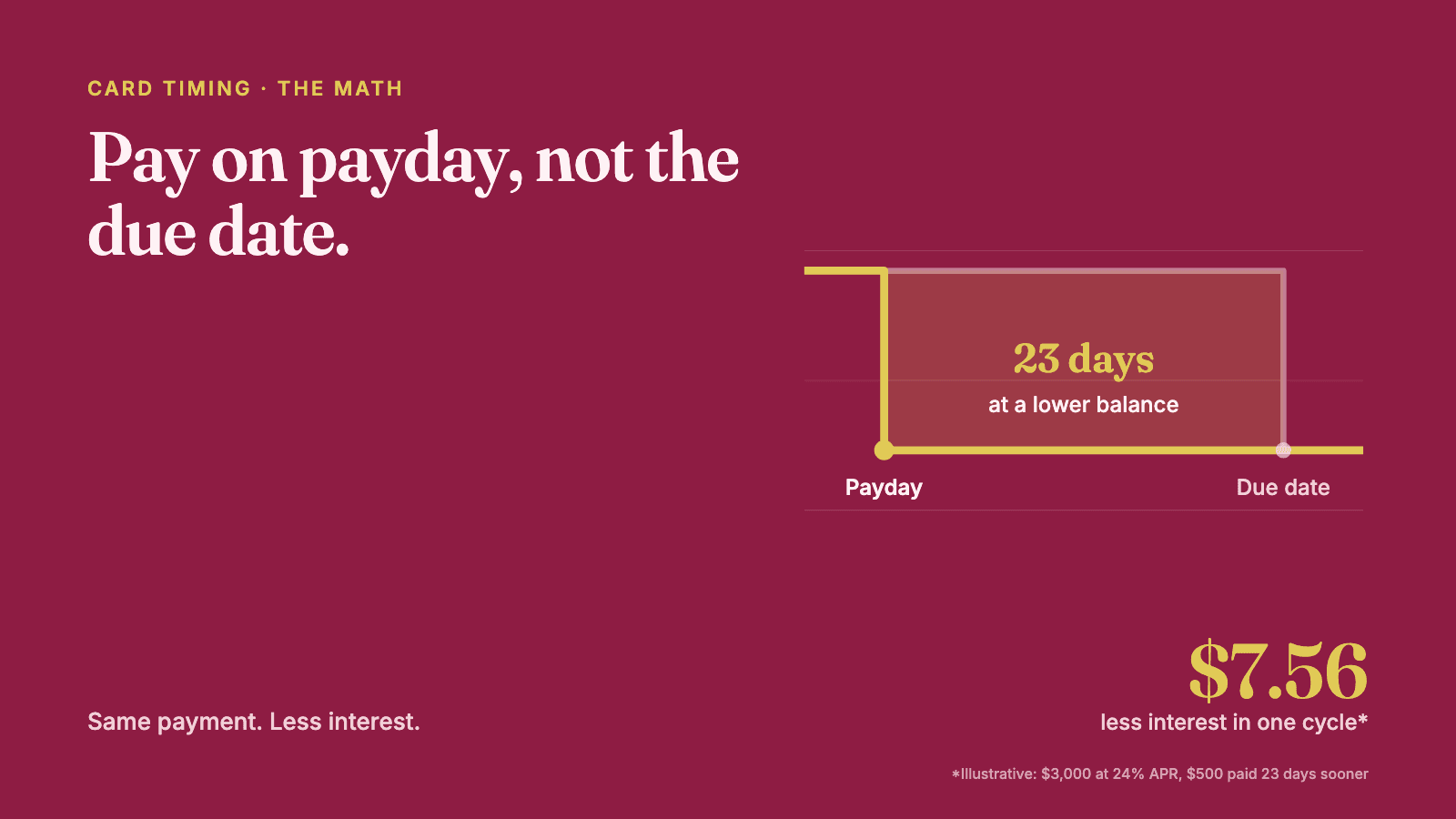
Short answer: yes, if you carry a balance. Most credit cards charge interest on your average daily balance, so every day a payment waits in checking instead of landing on the card costs you a little. The same payment, made earlier, means less interest. If you pay your full statement balance every month, timing mostly doesn't matter for interest.
How credit card interest is actually charged
Your APR isn't charged once a month. Most cards turn it into a daily rate and apply it to what you owe each day:
Daily rate = APR ÷ 365. A 24% APR is about 0.0658% a day.
Your interest for the month is based on your average daily balance: the balance on each day of the billing cycle, added up and divided by the number of days.
Many cards compound daily, so interest is added to the balance and then charged interest too.
Check your card agreement for the exact method. Some cards use 360 days instead of 365, but the idea is the same: a lower balance on more days means less interest.
The math, with one example
This is an illustrative example, not a promise about your card. Say you owe $3,000 at 24% APR in a 30-day billing cycle, and you're putting $500 toward it this month.
Pay on day 28 (near the due date): your balance stays at $3,000 for 27 days.
Pay on day 5 (right after payday): your balance drops to $2,500 for 23 more days.
Show data
| Day of billing cycle | Pay on the due date (day 28) | Pay on payday (day 5) |
|---|---|---|
| 1 | $3,000 | $3,000 |
| 4 | — | $3,000 |
| 5 | — | $2,500 |
| 27 | $3,000 | — |
| 28 | $2,500 | — |
| 30 | $2,500 | $2,500 |
Paying 23 days earlier lowers your average daily balance by $500 × 23 ÷ 30 = $383.33. At 24% APR that's $383.33 × 0.0658% × 30 days ≈ $7.56 less interest that month, from the exact same $500.
Pay on the due date
$58.19
Average daily balance $2,950.00
Pay on payday
$50.63
Average daily balance $2,566.67
Saved this cycle$7.56
Show data
| Value | ||
|---|---|---|
| Pay on the due date | $58.19 | Average daily balance $2,950.00 |
| Pay on payday | $50.63 | Average daily balance $2,566.67 |
| Saved this cycle | $7.56 |
Do that every month and, in this example, it's roughly $90 a year. Split your payment across every paycheck and the balance comes down even sooner. It isn't life-changing on its own, but it's free money, and it adds up across several cards.
Interest saved
Show data
| Interest saved | |
|---|---|
| 1 month | $7.56 |
| 6 months | $45.37 |
| 12 months | $90.74 |
When timing doesn't matter
If you pay your full statement balance by the due date every month, you usually keep your card's grace period, which means no interest on new purchases at all. In that case paying earlier won't save interest. It can still lower the balance your card reports to the credit bureaus, which is usually the balance on your statement date.
Once you carry a balance, most cards drop the grace period, and new purchases start collecting interest right away. That's when paying early starts to matter.
What about the “15/3 rule”?
You may have seen advice to pay 15 days and then 3 days before your due date. There's no special trick to those dates. What helps your interest is simply paying earlier, so your average daily balance is lower. What helps your credit score is a lower balance on the day your statement closes. Neither depends on hitting day 15 and day 3.
The catch: don't pay so early you come up short
Paying right after payday only works if you leave enough in checking for everything due before your next paycheck: rent, bills, groceries, and the minimum payments on your other cards. One overdraft fee or a missed payment wipes out months of interest savings.
So the real question isn't “when should I pay?” It's “how much can I safely pay right now?” That depends on your balance today, what's due before your next paycheck, and a small cushion for surprises.
A simple way to do it
On payday, look at your checking balance and add up everything due before your next payday.
Keep a cushion for the unexpected.
Put what's left toward your highest-interest card now, not on the due date.
Make sure every card still gets at least its minimum by its due date.
That's exactly the math Croft does for you. It reads your checking and your bills, and shows a live safe-to-pay number, so you can pay early without guessing.