
How to budget on irregular income and still pay down debt
Paid by the hour, in tips, by the job or on commission? Plan on your lowest normal month, not your average. Fill a one-month cushion first, then send a share of every good month to your highest-rate debt. Here's the method, with a worked example on a $6,000 card.

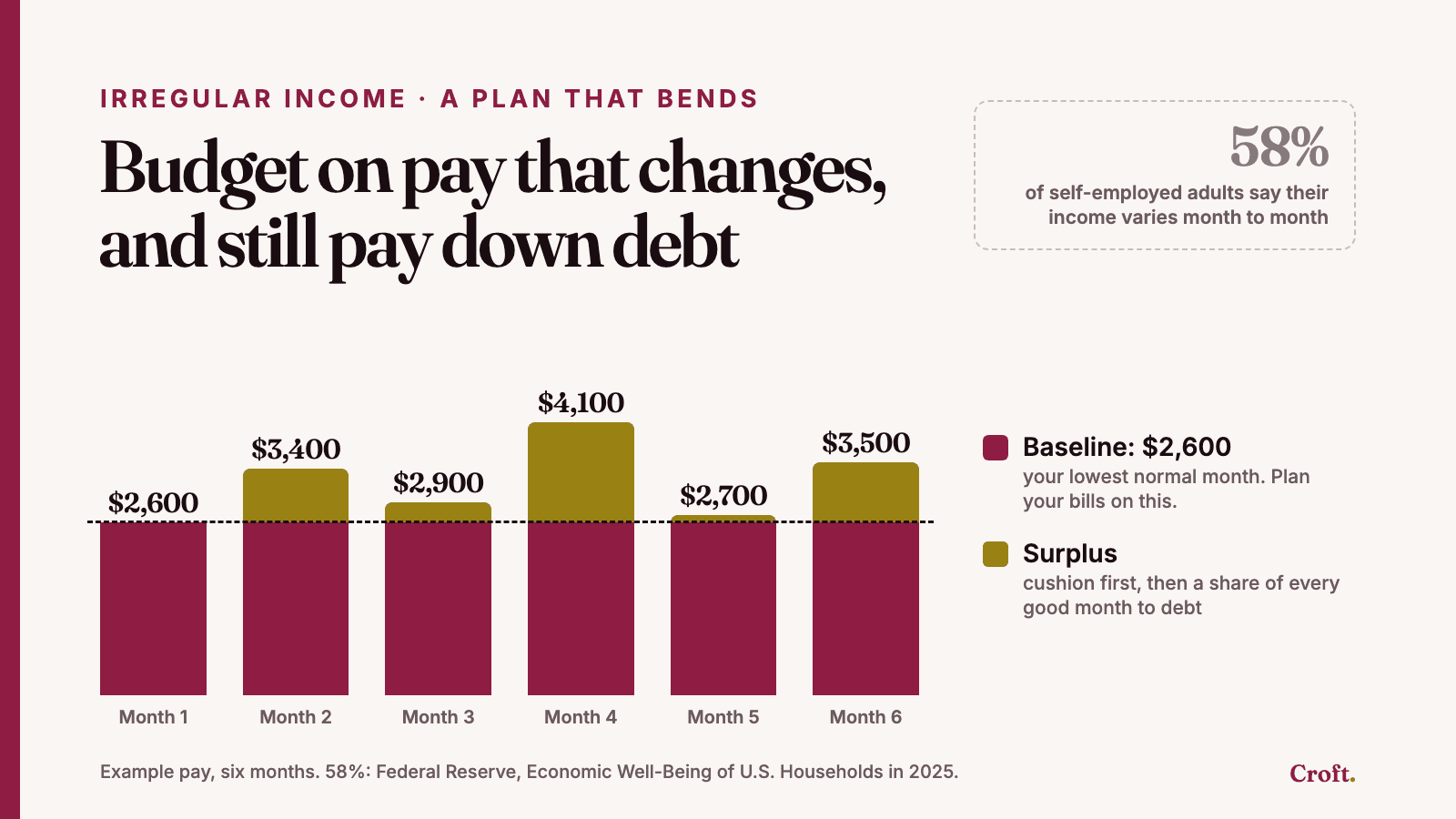
When your pay changes from month to month, build your budget on your lowest normal month, not your average. Then give every extra dollar a job in order: first a cushion of one month of bills, then bills that are coming up, then your highest-rate debt. Pay debt with a share of each good month, not a fixed amount you can't keep in a slow one.
That's the whole method. The rest of this post shows how to do each step, with a worked example: six months of uneven pay, a $6,000 card, and the math on how fast it gets paid off.
Why most budget advice doesn't fit you
Most budget advice starts with "take your monthly income." That works when every paycheck is the same. It breaks when you're paid by the hour, by the shift, in tips, by the job or on commission.
If you plan on an average month, every below-average month comes up short. Rent is the same in a slow month. So is the car payment. The gap goes on a card, and the card grows in the months you meant to pay it down.
You're not bad with money. You're using a plan built for a steady paycheck.
How common is income that changes?
Very common. In a Federal Reserve survey from October 2025, 30% of adults said their income varied at least now and then over the year. And 11% said they struggled to pay their bills in the past year because their income varied [1].
It's more common for some people than others [1]:
Self-employed: 58% said their income varied month to month, and 22% struggled to pay bills because of it.
Working for someone else: 28% said their income varied, and 10% struggled to pay bills because of it.
Family income under $25,000 a year: 46% had income that varied, and half of them (23% of the group) said it made bills hard to pay.
A steady job doesn't always mean steady pay. A JPMorganChase Institute study of hourly workers found that take-home pay changed in 7 out of every 10 months, even for people who stayed in the same job. The typical change was 9% from one month to the next. In 1 out of 4 months, it changed by 21% or more. Roughly half of these swings came from employers changing how many hours they needed [2].
And many people work for themselves. In July 2023, 11.9 million people were independent contractors in their main job. That's 7.4% of everyone with a job [3].
The method, step by step
1. Find your baseline
Your baseline is the least you take home in a normal month. Here's how to find it:
Look back over the last 6 to 12 months of deposits.
Write down what you took home each month, after taxes.
Pick the lowest month that wasn't a rare one-off, like a week out sick.
That number is your baseline. If you've been through a slow season, include it. Tag each kind of income as regular, seasonal or one-time. The Consumer Financial Protection Bureau (CFPB) says knowing which is which helps you get ready for months when less comes in [4].
If you're paid as a contractor (a 1099), take out what you set aside for taxes first. More on that below.
2. Budget to the baseline
Build your monthly plan so it fits inside your baseline. That plan covers rent, utilities, food, gas, insurance and the minimum on every debt.
If the plan doesn't fit, cut until it does, or plan to raise your baseline. That might mean more hours, a second client or a change you can count on. A plan that only works in a good month will put you on a card in a slow one.
3. Give extra money a job, in order
Anything above your baseline is surplus. Decide where it goes before it lands. Here's a good order:
Your cushion. Build up one month of your plan in checking. This is what carries you through a slow month without a card.
Bills coming up. Set aside money for big bills that don't come every month. Think car insurance, a yearly fee or a tax payment.
Your highest-rate debt. Send extra to the debt with the highest APR (the yearly interest rate). Keep paying the minimums on the rest.
Once the cushion is full, it only needs topping up after you use it.
4. Pay debt with a share of surplus, not a fixed amount
"Pay $500 extra every month" sounds like a good rule. But in a $100 surplus month, the extra $500 has to come from somewhere. Usually it comes out of your cushion, or it goes back on a card.
Instead, pick a share: say 80% of each month's surplus goes to the debt. In a big month, you pay a lot. In a slow month, you pay little or nothing extra, and your cushion stays whole. The other 20% stays with you for slow seasons, surprises and a little breathing room.
5. Plan for slow seasons
If your work has a slow season, write down when it usually starts and how long it lasts. Then count how many months of your plan you'll need to get through it. If it's more than one, keep saving past one month before it starts.
You can also call the companies you pay. The CFPB suggests asking to move a due date so it lines up better with when you get paid. Many will say yes if you ask [5].
6. If you're self-employed, set aside taxes first
When no one takes taxes out of your pay, you have to pay them during the year. The IRS says you generally need to make estimated tax payments if you expect to owe $1,000 or more when you file [6]. That tax includes self-employment tax, which is 15.3% for Social Security and Medicare. You owe it if your net earnings from self-employment are $400 or more [7].
For 2026, the four due dates are April 15, June 15 and September 15, 2026, and January 15, 2027 [8]. You can also pay weekly or monthly, as long as enough is paid by the end of each quarter [6]. If you don't pay enough by each date, you may owe a penalty [6].
The easy habit: each time a client pays, move your tax share to a separate savings account before you do anything else. Then count only what's left as income. How much to set aside depends on your situation. The worksheet in IRS Form 1040-ES walks you through it [8], or ask a tax pro.
A worked example
Let's use round numbers. These aren't one real person's numbers. They're an example to show the math.
Say you take home this much over six months, after taxes:
Month | Take-home | Baseline | Surplus |
|---|---|---|---|
1 | $2,600 | $2,600 | $0 |
2 | $3,400 | $2,600 | $800 |
3 | $2,900 | $2,600 | $300 |
4 | $4,100 | $2,600 | $1,500 |
5 | $2,700 | $2,600 | $100 |
6 | $3,500 | $2,600 | $900 |
Your average month is $3,200. But your lowest month is $2,600, so that's your baseline. Your whole monthly plan fits in $2,600, and that includes a $150 payment on your credit card. Over the six months, you have $3,600 in surplus, or $600 a month on average.
Show data
| Month | Take-home pay | Baseline (lowest month) |
|---|---|---|
| 1 | $2,600 | $2,600 |
| 2 | $3,400 | $2,600 |
| 3 | $2,900 | $2,600 |
| 4 | $4,100 | $2,600 |
| 5 | $2,700 | $2,600 |
| 6 | $3,500 | $2,600 |
You owe $6,000 on a card at 22.36% APR. That's the Federal Reserve's average rate for card accounts that paid interest in August 2026 [9]. We'll say the same six months repeat, and you don't add new charges to the card.
If you only pay $150 a month, the card takes 75 months to pay off, more than six years. You pay $5,113.30 in interest.
If you follow the method:
Months 1 to 4: every dollar of surplus goes to your cushion. By month 4, you have $2,600 saved. That's one month of your plan.
Month 5 on: 80% of each month's surplus goes to the card. In month 5, that's $80. In month 6, it's $720. In a $0 month, it's $0, and that's OK.
The card is paid off in month 16. You pay $1,164.48 in interest. That's $3,948.82 less than paying $150 a month, and almost five years sooner. You still have your $2,600 cushion, plus $1,440 from the 20% you kept.
Show data
| Months | $150 a month only | 80% of surplus |
|---|---|---|
| 0 | $6,000 | $6,000 |
| 1 | $5,961.80 | $5,961.80 |
| 2 | $5,922.89 | $5,922.89 |
| 3 | $5,883.25 | $5,883.25 |
| 4 | $5,842.87 | $5,842.87 |
| 5 | $5,801.74 | $5,721.74 |
| 6 | $5,759.85 | $4,958.36 |
| 7 | $5,717.18 | $4,900.75 |
| 8 | $5,673.71 | $4,202.07 |
| 9 | $5,629.43 | $3,890.37 |
| 10 | $5,584.33 | $2,612.86 |
| 11 | $5,538.38 | $2,431.55 |
| 12 | $5,491.58 | $1,606.86 |
| 13 | $5,443.91 | $1,486.80 |
| 14 | $5,395.35 | $724.50 |
| 15 | $5,345.88 | $348 |
| 16 | $5,295.49 | $0 |
| 17 | $5,244.16 | $0 |
| 18 | $5,191.88 | $0 |
| 19 | $5,138.62 | $0 |
| 20 | $5,084.37 | $0 |
| 21 | $5,029.11 | $0 |
| 22 | $4,972.82 | $0 |
| 23 | $4,915.48 | $0 |
| 24 | $4,857.07 | $0 |
| 25 | $4,797.57 | $0 |
| 26 | $4,736.96 | $0 |
| 27 | $4,675.23 | $0 |
| 28 | $4,612.35 | $0 |
| 29 | $4,548.29 | $0 |
| 30 | $4,483.04 | $0 |
| 31 | $4,416.57 | $0 |
| 32 | $4,348.87 | $0 |
| 33 | $4,279.90 | $0 |
| 34 | $4,209.65 | $0 |
| 35 | $4,138.09 | $0 |
| 36 | $4,065.20 | $0 |
| 37 | $3,990.95 | $0 |
| 38 | $3,915.31 | $0 |
| 39 | $3,838.27 | $0 |
| 40 | $3,759.79 | $0 |
| 41 | $3,679.85 | $0 |
| 42 | $3,598.42 | $0 |
| 43 | $3,515.47 | $0 |
| 44 | $3,430.97 | $0 |
| 45 | $3,344.90 | $0 |
| 46 | $3,257.23 | $0 |
| 47 | $3,167.92 | $0 |
| 48 | $3,076.95 | $0 |
| 49 | $2,984.28 | $0 |
| 50 | $2,889.89 | $0 |
| 51 | $2,793.74 | $0 |
| 52 | $2,695.80 | $0 |
| 53 | $2,596.03 | $0 |
| 54 | $2,494.40 | $0 |
| 55 | $2,390.88 | $0 |
| 56 | $2,285.43 | $0 |
| 57 | $2,178.02 | $0 |
| 58 | $2,068.60 | $0 |
| 59 | $1,957.14 | $0 |
| 60 | $1,843.61 | $0 |
| 61 | $1,727.96 | $0 |
| 62 | $1,610.16 | $0 |
| 63 | $1,490.16 | $0 |
| 64 | $1,367.93 | $0 |
| 65 | $1,243.42 | $0 |
| 66 | $1,116.59 | $0 |
| 67 | $987.40 | $0 |
| 68 | $855.80 | $0 |
| 69 | $721.75 | $0 |
| 70 | $585.20 | $0 |
| 71 | $446.10 | $0 |
| 72 | $304.41 | $0 |
| 73 | $160.08 | $0 |
| 74 | $13.06 | $0 |
| 75 | $0 | $0 |
What about a fixed $480 a month? That's the same as 80% of your average surplus. In this example, the card is paid off a month sooner, in month 15, with $89.09 less interest. But to make the $480 payment in slow months, you have to dip into your cushion. It falls below one month of your plan three times, down to $2,160 at its lowest. If a car repair hits in one of those months, it goes on a card.
Show data
| Months | 80% of surplus | Fixed $480 extra |
|---|---|---|
| 0 | $0 | $0 |
| 1 | $0 | $0 |
| 2 | $800 | $800 |
| 3 | $1,100 | $1,100 |
| 4 | $2,600 | $2,600 |
| 5 | $2,600 | $2,220 |
| 6 | $2,600 | $2,640 |
| 7 | $2,600 | $2,160 |
| 8 | $2,600 | $2,480 |
| 9 | $2,600 | $2,300 |
| 10 | $2,600 | $3,320 |
| 11 | $2,600 | $2,940 |
| 12 | $2,600 | $3,360 |
So the fixed plan isn't wrong. It just borrows from your safety net to save a little interest. And if your slow season lasts longer than one month, the dips get deeper.
Common mistakes
Budgeting on your best month, or your average. Every month below it comes up short.
Spending a big month right away. Give it a job first: cushion, bills coming up, then debt.
Skipping the cushion to pay debt faster. Without it, the next slow month goes on a card.
Promising a fixed extra payment. It works until the first slow month.
Forgetting taxes on contract work. A tax bill in April can undo a year of progress.
Treating money as "in" before it lands. A client who pays late can leave you short. Count it once it's in your account.
Your checklist
Write down your take-home for each of the last 6 to 12 months.
Circle your lowest normal month. That's your baseline.
Make a monthly plan that fits inside it, minimums included.
If you're self-employed, move your tax share out as each payment lands.
Build a cushion of one month of your plan.
Set aside money for big bills that don't come every month.
Send a set share of each month's surplus to your highest-rate debt.
Mark your slow season on a calendar and save for it ahead of time.
How Croft helps
Croft is built for paycheck-to-paycheck budgets, and that includes pay that changes. Here's what it does today:
It asks how money comes in. If Croft can't find a regular paycheck, setup asks, "How does money usually come in?" If you pick "It varies" (for your business, clients, commission or tips), Croft looks 30 days ahead instead of to a payday. You can change your answer any time in Settings.
You choose your cushion. Croft sets aside your next 30 days of bills first. Then you choose how much more stays in checking: a month of bills (the safer choice, and the one picked for you in setup), two months of bills, or a smaller amount so more goes to debt.
It shows what's safe to put toward debt right now. Croft walks your checking balance forward day by day for 30 days, with your bills and debt minimums. It finds the lowest point, then takes off the cushion you chose. What's left is the number. It updates any time money comes in or goes out.
Money you're expecting doesn't count until it lands. You can add a client payment you're waiting for. Croft shows it in your next 30 days, but it won't count it toward debt until it's in your account. That way a late payment can't leave you short.
No bills, no number. If Croft doesn't know your bills yet, it won't show a "safe" number at all. It asks you to add your bills first.
You can ask Croft. Try "What did I spend in each category over the last three full months?" or "When's my tightest day?"
Croft doesn't work out your taxes. Set your tax share aside on your own, as in step 6.
The short version
When your pay changes, plan on your lowest normal month. Fill a one-month cushion first. Then send a share of every good month to your highest-rate debt. Slow months stop being emergencies, and good months do the heavy lifting.
Sources
Board of Governors of the Federal Reserve System, "Economic Well-Being of U.S. Households in 2025" (May 2026; survey fielded October 2025), section "Income Variability," pages 31–32. https://www.federalreserve.gov/publications/files/2025-report-economic-well-being-us-households-202605.pdf
JPMorganChase Institute, "Earnings instability: The hidden volatility of American workers' paychecks" (September 30, 2025; research by Ganong, Noel, Patterson, Vavra and Weinberg, hourly workers). https://www.jpmorganchase.com/institute/all-topics/financial-health-wealth-creation/earnings-instability
U.S. Bureau of Labor Statistics, "Contingent and Alternative Employment Arrangements — July 2023" (news release USDL-24-2267, November 8, 2024). https://www.bls.gov/news.release/conemp.nr0.htm
Consumer Financial Protection Bureau, "Your Money, Your Goals: Income and benefits tracker" (August 2021). https://files.consumerfinance.gov/f/documents/cfpb_income-benefits-tracker_tool_2021-08.pdf
Consumer Financial Protection Bureau, "Behind on bills: Three steps to help you make tough choices in tight moments" (August 10, 2017). https://www.consumerfinance.gov/archive/blog/behind-bills-three-steps-help-you-make-tough-choices-tight-moments/
Internal Revenue Service, "Estimated taxes" (last reviewed or updated September 25, 2026). https://www.irs.gov/businesses/small-businesses-self-employed/estimated-taxes
Internal Revenue Service, "Self-employment tax (Social Security and Medicare taxes)" (last reviewed or updated June 27, 2026). https://www.irs.gov/businesses/small-businesses-self-employed/self-employment-tax-social-security-and-medicare-taxes
Internal Revenue Service, Form 1040-ES, "Estimated Tax for Individuals" (2026). https://www.irs.gov/pub/irs-pdf/f1040es.pdf
Federal Reserve Board, G.19 Consumer Credit, release of October 7, 2026 (August 2026: credit card plans, accounts assessed interest, 22.36%). https://www.federalreserve.gov/releases/g19/current/default.htm